Reflections
The Default Mode Network: The Brain Network Behind Your Sense of Self
The default mode network becomes active when attention turns inward. Explore its role in memory, self-awareness, and the sense of self—and what research reveals about meditation, psychedelics, and the limits of current understanding.
By Nick Moffo · Published October 29, 2026 · 15 min read
What happens inside your brain when you stop paying attention to the world around you?
You might assume that your brain becomes quieter. After all, you're no longer solving problems, processing instructions, or concentrating on a particular task.
But neuroscience has revealed something fascinating: when your attention turns inward, a collection of interconnected brain regions often becomes especially active.
This system is known as the default mode network, or DMN.
Researchers have linked it to remembering the past, imagining the future, thinking about other people, and reflecting on who we are. It also plays a prominent role in scientific investigations of meditation, consciousness, and psychedelic experiences.
Some researchers believe that understanding this network could help explain how the brain maintains our everyday sense of self—and why that sense of self can sometimes change so dramatically.
But does the default mode network actually create the ego? And what does it mean when psychedelics alter its activity?
The science is more interesting, and more complicated, than the popular explanations suggest.
What Is the Default Mode Network?
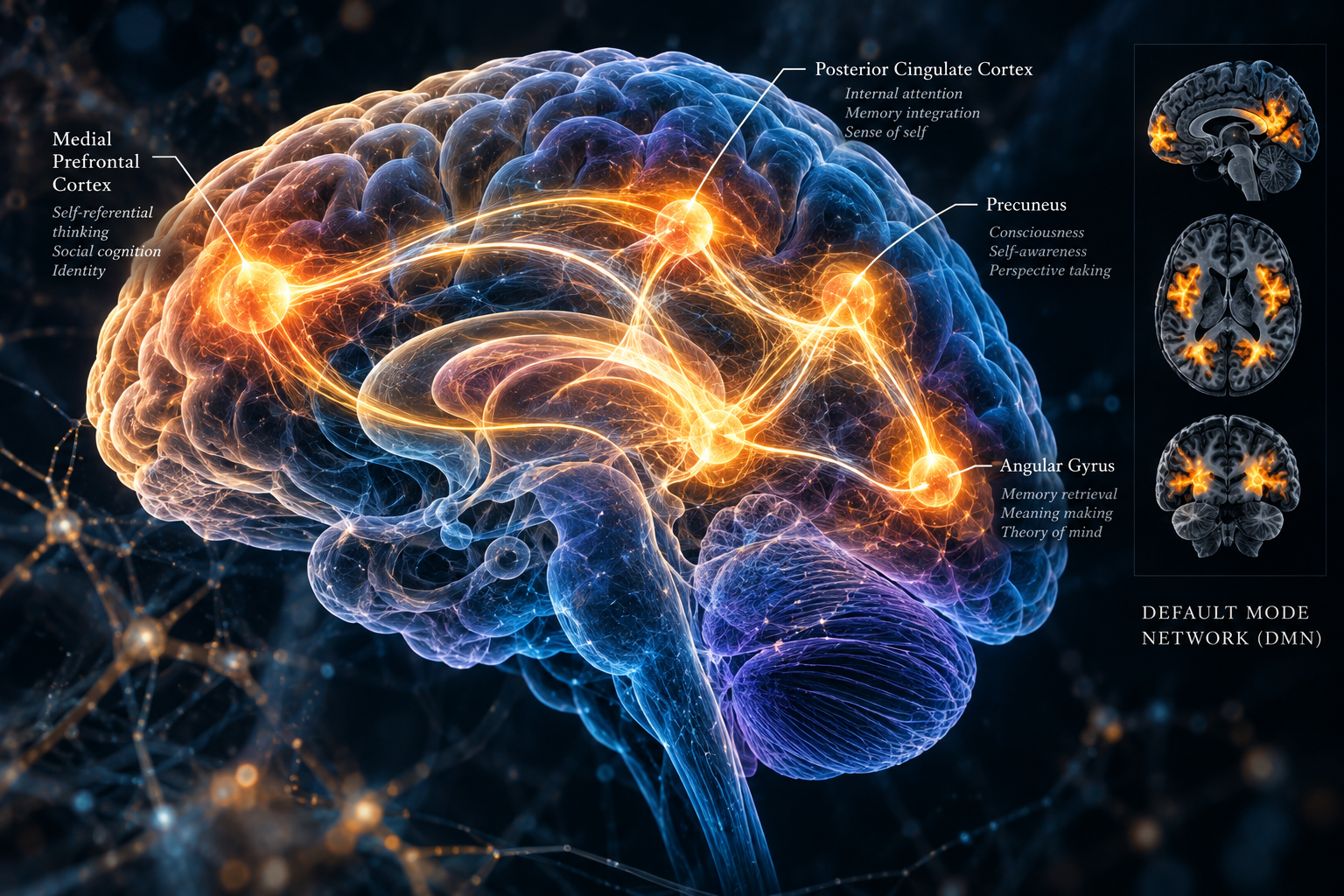
The default mode network is a collection of interconnected brain regions that show coordinated activity, particularly during periods of internally directed thought.
It is not a single physical structure. Rather, it is a functional network: a group of regions that communicate and fluctuate together.
Some of its major components include:
- Medial prefrontal cortex: Involved in aspects of self-referential thinking, evaluation, and social cognition.
- Posterior cingulate cortex and precuneus: Important hubs associated with internally directed attention, memory, and the integration of information.
- Angular gyrus and neighboring parietal regions: Involved in processes including memory retrieval and constructing meaningful representations.
- Medial temporal regions: Contribute to remembering personal experiences and imagining possible future events.
These regions do not operate exclusively within the DMN. Each participates in multiple functions, and the network itself contains distinct interacting subsystems.
Researchers often observe stronger DMN activity when someone is resting quietly, remembering an event, imagining a conversation, or thinking about their own life.
However, the term default can be misleading.
The DMN is not simply an idle setting that switches on whenever we stop working. It can also contribute to demanding tasks that require autobiographical memory, social understanding, or imagination.
Its importance lies in the kinds of mental activity it supports, not merely in whether someone is resting.
How Scientists Discovered the Brain's Default Network
For much of the twentieth century, researchers focused on identifying brain regions that became more active when people performed particular tasks.
A participant might read words, move a finger, or solve a problem while scientists measured changes in brain activity.
But researchers began noticing something unexpected.
Certain brain regions consistently showed lower activity during externally focused tasks than during baseline conditions.
In other words, some areas appeared particularly active when participants were not concentrating on the experimental task.
In 2001, neuroscientist Marcus Raichle and colleagues published a landmark paper titled A Default Mode of Brain Function.
Their work helped establish that the resting brain possesses an organized baseline pattern of activity rather than merely producing random background signals.
Subsequent research showed that several regions within this system display correlated fluctuations in their activity.
These findings helped establish the default mode network as one of the major large-scale networks studied in human neuroscience.
A major review by Buckner, Andrews-Hanna, and Schacter in 2008 connected the network to autobiographical memory, imagining the future, and understanding other people's perspectives.
The discovery challenged a simple assumption: the brain is not necessarily doing less meaningful work when our attention turns away from the outside world.
Sometimes, it is constructing the inner world through which we understand our lives.
The Default Mode Network and Your Sense of Self
Consider the last time you thought about an embarrassing memory.
Perhaps you replayed the conversation, imagined what you should have said, and wondered what another person thought of you.
Now consider imagining yourself five years from today.
You might picture your career, relationships, home, or the person you hope to become.
Although one experience concerns the past and the other concerns the future, both require the brain to construct a representation of you.
The DMN is involved in several processes that make these experiences possible.
The autobiographical self
Our identity depends partly on autobiographical memory: the ability to connect experiences into a personal history.
You recognize yourself as the same person who existed yesterday, even though your thoughts, emotions, and circumstances have changed.
DMN-related regions participate in retrieving personal memories and using them to construct imagined situations.
This helps explain why the network is relevant to the continuity of identity.
However, it would be inaccurate to suggest that autobiographical memory or personal identity resides entirely within the DMN.
Both depend on interactions among multiple brain systems.
The narrative self
Psychologists sometimes distinguish between the immediate experience of being aware and the narrative self: the story we construct about who we are.
That story includes our beliefs, memories, ambitions, insecurities, and interpretations of past experiences.
When you think, "I'm someone who always struggles with change," you are not simply perceiving the present moment.
You are interpreting yourself through a broader personal narrative.
The DMN's involvement in self-referential thinking makes it relevant to this process.
But the relationship is not one-to-one. The network also supports thinking about other people, imagining fictional situations, and considering events that have nothing to do with our own identity.
The DMN contributes to constructing our sense of self, but it is not synonymous with the self.
Is the Default Mode Network the Source of the Ego?
In discussions of psychedelics and consciousness, the DMN is sometimes described as the brain's "ego center."
This description is memorable, but scientifically oversimplified.
The term ego has different meanings in psychology, philosophy, and everyday language. It can refer to personal identity, self-awareness, psychological defenses, or the feeling of being a separate individual.
These experiences cannot currently be reduced to a single brain network.
The DMN is associated with several processes that contribute to self-related thought, but other systems are also involved.
The salience network helps detect important internal and external events. Executive-control networks contribute to attention and goal-directed thinking. Sensory and bodily systems help maintain our immediate experience of being located within a body.
Our sense of self appears to emerge from interactions among these systems rather than from one isolated neural mechanism.
That distinction becomes particularly important when examining psychedelic research.
If a person temporarily experiences a reduced sense of separation between themselves and the surrounding world, it does not necessarily mean their DMN has simply switched off.
The underlying neuroscience is considerably more complex.
What Happens to the DMN During Psychedelic Experiences?
Classic psychedelics such as psilocybin and LSD can profoundly alter perception, emotion, and self-experience.
Researchers have used brain-imaging techniques to investigate how these substances affect large-scale neural networks.
A landmark 2012 study led by Robin Carhart-Harris examined brain activity under psilocybin.
Using functional magnetic resonance imaging and related measures, researchers observed decreases in activity and changes in connectivity involving important brain hubs, including regions associated with the default mode network.
The findings challenged the assumption that psychedelic experiences necessarily involve a simple overall increase in brain activity.
Instead, the results suggested that changes in the organization and coordination of brain activity may be central to the psychedelic state.
Importantly, these measurements reflect aspects of neural activity and blood flow—not direct recordings of consciousness itself.
Psilocybin and the changing sense of self
In 2015, Alexander Lebedev and colleagues investigated the neural correlates of ego dissolution under psilocybin.
Ego dissolution describes a subjective experience in which the usual boundaries between oneself and the surrounding world seem to weaken or disappear.
In a placebo-controlled study involving 15 healthy participants, researchers examined brain connectivity and participants' reports of altered self-experience.
They found associations between ego dissolution and changes involving communication between medial temporal and cortical regions, as well as alterations in the salience network and communication between the brain's hemispheres.
These findings suggested that changes in self-experience involve multiple interacting systems.
The study did not establish that the DMN alone produces the ego, nor that disrupting one network is sufficient to create ego dissolution.
It demonstrated a relationship between particular brain-connectivity patterns and subjective experiences in a small experimental sample.
LSD and brain-network communication
A 2016 neuroimaging study also examined the effects of LSD on human brain activity.
Researchers observed changes in visual processing, electrical activity, and communication between brain regions.
Of particular interest, reduced connectivity between the parahippocampus and retrosplenial cortex was associated with participants' reports of ego dissolution and altered meaning.
These findings support the broader idea that our ordinary sense of self depends on coordinated communication among distributed brain regions.
They do not establish a universal neural explanation for every psychedelic experience.
The effects of psychedelics vary across individuals, experimental conditions, and the measures researchers use.
Does Ego Dissolution Reveal the Nature of Consciousness?
The relationship between psychedelic experiences and consciousness raises a deeper question.
If our normal sense of identity can temporarily change, what does that tell us about the nature of the self?
One interpretation is that the familiar feeling of being a separate, continuous individual depends on brain processes that can be altered.
Under ordinary conditions, those processes may help organize memories, perceptions, bodily sensations, and expectations into a relatively stable experience.
During certain altered states, that organization may change.
People sometimes report feeling less identified with their personal history, experiencing a diminished boundary between self and environment, or perceiving familiar aspects of reality in unfamiliar ways.
These experiences are scientifically relevant because they offer researchers an opportunity to investigate the neural mechanisms associated with self-awareness.
However, subjective reports of unity or ego dissolution do not, by themselves, establish philosophical conclusions about the ultimate nature of consciousness.
They do not prove that consciousness exists independently of the brain, that individual identity is an illusion, or that all minds share a single underlying awareness.
Such interpretations belong to broader philosophical discussions.
Neuroscience can investigate the conditions under which experiences arise and change. Explaining why physical processes are accompanied by subjective experience remains a deeper unresolved problem.
For a broader introduction, see What Is Consciousness? Understanding the Nature of Awareness.
Meditation, Mind-Wandering, and the DMN
Psychedelics are not the only subject of research involving changes in default mode network activity.
Meditation offers another way to study the relationship between attention, self-referential thought, and brain-network organization.
In 2011, Judson Brewer and colleagues compared experienced meditators with meditation-naive participants.
During several meditation practices, experienced meditators showed relatively reduced activity in important DMN regions, including the posterior cingulate cortex and medial prefrontal cortex.
The researchers also observed differences in connectivity between DMN regions and areas involved in cognitive control.
These findings were consistent with participants' reports of reduced mind-wandering.
The study suggested that meditation experience is associated with changes in how networks involved in internally directed thought and attention interact.
But it did not demonstrate that meditation permanently shuts down the DMN.
Nor would that necessarily be desirable.
Remembering our past, imagining our future, and reflecting on our relationships are valuable human abilities.
The goal is not to eliminate self-related thought. A more useful scientific question is how flexibly the brain shifts between internal reflection and attention to the present environment.
The DMN, Depression, and Repetitive Thinking
Self-reflection can be constructive.
It allows us to learn from experience, plan for the future, and consider the consequences of our actions.
But internally focused thinking can also become repetitive and distressing.
Rumination refers to recurring patterns of thought, often centered on negative emotions, perceived failures, or unresolved concerns.
Researchers have investigated associations between rumination, depression, and altered communication within and between large-scale brain networks, including the DMN.
However, depression cannot be explained simply as an overactive default mode network.
Findings vary across studies, and mental health conditions involve biological, psychological, and environmental factors.
The clinical relevance of the DMN is particularly interesting in psychedelic research.
Psilocybin therapy and network flexibility
In 2022, Richard Daws and colleagues published a study in Nature Medicine examining changes in brain connectivity following psilocybin therapy for depression.
The researchers analyzed functional MRI data from two clinical trials, including a randomized comparison involving psilocybin and escitalopram.
They found that antidepressant responses following psilocybin therapy were associated with reductions in brain-network modularity—a measure of how strongly networks remain separated from one another.
This pattern was interpreted as increased global integration between brain networks.
In simplified terms, brain systems that normally communicate within relatively distinct groups appeared to become more interconnected.
The findings suggested a possible relationship between changes in network organization and improvement in depressive symptoms.
However, these results do not prove that increased integration causes recovery, nor do they establish that the same mechanism explains every therapeutic response.
The studies involved clinical treatment settings, and their results should not be generalized to unsupervised psychedelic use.
Can the Default Mode Network Change Through Neuroplasticity?
The brain is not a fixed system.
Through neuroplasticity, neural connections and patterns of activity can change in response to learning, experience, development, and other influences.
Large-scale functional networks can also display changing patterns of coordination.
This does not necessarily mean that every temporary change in functional connectivity reflects lasting structural rewiring.
That distinction matters when interpreting research on meditation and psychedelics.
A brain scan showing altered communication between regions provides information about functional organization at a particular time.
It does not automatically demonstrate the formation of new synapses, permanent changes in identity, or long-term psychological improvement.
Some psychedelic research investigates cellular and synaptic plasticity, while other studies examine changes in large-scale brain connectivity.
These approaches address related but distinct questions.
Understanding how molecular changes, neural circuits, and subjective experience relate to one another remains an important scientific challenge.
For more on this distinction, explore Neuroplasticity: How the Brain Changes, Adapts, and Rewires Itself and Psychedelics and Neuroplasticity: What Does the Research Actually Show?.
What Scientists Still Don't Know
Despite decades of research, several major questions remain unresolved.
How directly does DMN activity correspond to the experience of self?
Researchers have identified meaningful associations, but no single network measure fully captures personal identity or subjective awareness.
Why do psychedelic experiences vary so widely?
Brain activity interacts with psychological expectations, individual differences, and environmental context. Neural connectivity alone cannot explain every reported experience.
Are changes in network integration responsible for therapeutic benefits?
Some clinical findings support this possibility, but establishing causation requires additional research.
Can changes in the DMN reliably predict long-term psychological outcomes?
Current evidence does not support using a simple DMN measurement as a universal indicator of mental health, spiritual development, or psychological transformation.
What is the relationship between brain networks and consciousness itself?
Neuroscience can identify mechanisms associated with awareness and self-experience, but the relationship between neural activity and subjective experience remains an active scientific and philosophical debate.
These uncertainties do not diminish the importance of the research.
They define where the most meaningful questions remain.
Conclusion: The Brain Behind the Story of You
The default mode network has changed how scientists understand the resting brain.
Rather than becoming inactive when external demands fade, the brain continues to organize memories, imagine possibilities, consider relationships, and construct aspects of our personal identity.
The DMN participates in many of these processes, making it an important part of the neuroscience of self-referential thought.
Research involving meditation, psilocybin, and LSD has shown that patterns of brain-network activity and communication can change alongside alterations in attention and self-experience.
Yet the DMN is not simply an ego switch, and its activity cannot fully explain consciousness.
Perhaps the most compelling insight is that our ordinary sense of self is not entirely fixed.
It depends on dynamic biological processes that continuously integrate memory, perception, attention, and experience.
Understanding those processes does not settle the mystery of consciousness.
But it offers a more precise scientific framework for exploring one of the most personal questions we can ask:
How does the brain construct the experience of being you?
Scientific References
- Raichle, M. E., et al. (2001). A default mode of brain function. Proceedings of the National Academy of Sciences, 98(2), 676–682. https://doi.org/10.1073/pnas.98.2.676
- Buckner, R. L., Andrews-Hanna, J. R., & Schacter, D. L. (2008). The brain's default network: Anatomy, function, and relevance to disease. Annals of the New York Academy of Sciences, 1124, 1–38. https://doi.org/10.1196/annals.1440.011
- Andrews-Hanna, J. R., et al. (2010). Functional-anatomic fractionation of the brain's default network. Neuron, 65(4), 550–562. https://doi.org/10.1016/j.neuron.2010.02.005
- Carhart-Harris, R. L., et al. (2012). Neural correlates of the psychedelic state as determined by fMRI studies with psilocybin. Proceedings of the National Academy of Sciences, 109(6), 2138–2143. https://doi.org/10.1073/pnas.1119598109
- Lebedev, A. V., et al. (2015). Finding the self by losing the self: Neural correlates of ego-dissolution under psilocybin. Human Brain Mapping, 36(8), 3137–3153. https://doi.org/10.1002/hbm.22833
- Carhart-Harris, R. L., et al. (2016). Neural correlates of the LSD experience revealed by multimodal neuroimaging. Proceedings of the National Academy of Sciences, 113(17), 4853–4858. https://doi.org/10.1073/pnas.1518377113
- Brewer, J. A., et al. (2011). Meditation experience is associated with differences in default mode network activity and connectivity. Proceedings of the National Academy of Sciences, 108(50), 20254–20259. https://doi.org/10.1073/pnas.1112029108
- Daws, R. E., et al. (2022). Increased global integration in the brain after psilocybin therapy for depression. Nature Medicine, 28, 844–851. https://doi.org/10.1038/s41591-022-01744-z
Editorial note: This article is intended for educational purposes. It summarizes neuroscience and psychedelic research without recommending or instructing substance use.